Analysis reliability
How ContentGrapher applies determinism so your edits stay measurable
Picture a technical guide you have spent the morning revising. Before you touched a word, you ran it through ContentGrapher and saw two clear problems: the section on HTTP cache-control headers barely scratched the surface, and cache invalidation was missing altogether. So you rewrote the headers section, added two crisp paragraphs on how invalidation works, published the update, and clicked Re-analyze.
The only thing you want from that second run is a straight answer to a plain question: did those edits close the gaps? When we tested our own pipeline on repeat runs across 232 untouched pages, we discovered something that gets in the way of that answer: even on identical prose, open re-discovery rotated four to six of every twenty concepts. If the concept list shifts underneath your revision, you cannot tell whether the score moved because of your writing or because the scoreboard changed.
The short answer
Useful determinism for editors is neither a frozen score nor a keyword counter. In ContentGrapher, we put determinism in the structure and evidence (your baseline concept list, mention counts, verbatim quotes, and stable roles) and keep semantic judgment live in the prose, so every before-and-after reading reflects your actual edits.
What we found across 232 unchanged pages
We caught this problem while validating another improvement. When we raised ContentGrapher's map limit from 15 to 20 concepts, we ran paired repeat analyses across 232 held-out pages without altering a single character. Raising the cap did two things we wanted: within-page score spread fell by 25% (from 0.0333 to 0.0250), and false “missing concept” flags dropped because secondary topics stopped getting cut off.
Yet the list of concepts itself still drifted. On identical text, only 73.5% of concepts carried over on English pages and 77.9% overall (see the Reliability Study for how we measure repeat variance). Four to six of every twenty concepts still dropped out, changed wording, or swapped places on a second pass over the exact same article.
Baseline concepts retained on a second run (232 untouched pages)
On identical text across 232 pages, open re-discovery carried over 73.5% of concepts on English pages and 77.9% overall (set overlap / Jaccard similarity). Holding your Run 1 concept list in application code keeps all 20 baseline concepts intact on every follow-up run.
On a one-off audit, that variance is invisible. You never see the alternate 20 concepts the model might have picked five minutes later. It only hurts the moment a writer uses the report as intended: editing the page and running a second check. Because the text changed, the pipeline has to bypass the cache and read your draft fresh. If it also invents a fresh concept list on that pass, your revision gets graded against a moving ruler.
Why “100% deterministic” is the wrong goal
When we sat down to fix repeat-run drift, two shortcuts were immediately off the table. The first is freezing the report behind a cache: repeatable, certainly, and completely useless the moment you revise a paragraph. The second is replacing language-model reading with exact keyword counts: deterministic to the last decimal, and blind to whether a page actually teaches the reader anything.
A keyword counter cannot tell the difference between mentioning cache invalidation three times in a bullet list and actually explaining how surrogate keys purge stale edge objects. An editor does not want a pipeline that ignores prose quality in the name of repeatability. An editor wants a pipeline that holds the ruler still while reading the new words honestly.
Where we apply determinism, and where reading stays live
Our answer is selective determinism across five layers of the pipeline, enforced in application code rather than hoped for in a prompt. Run 1 maps what is already on your page (up to 20 concepts). From Run 2 onward, code holds the frame steady: the model evaluates your numbered baseline slots while application code binds your exact concept IDs, labels, and core topic, counts mentions directly in your text, verifies every verbatim quote against the page, and returns identical re-runs in milliseconds by matching the text fingerprint.
Inside ContentGrapher's pipeline · Determinism vs. live reading
Your concept list after Run 1
Run 2+ scores concepts by fixed slot number while our code binds your Run 1 IDs, labels, and core topic. Nothing silently drops or renames.
Mention counts & verbatim quotes
Every mention count and supporting quote is checked directly against your prose. If a quote is not literally on the page, it is stripped out.
Boundary roles while the page keeps its job
Core, supportive, adjacent, and excluded labels stay steady across revisions whenever the page keeps the same reader purpose.
Identical-text reuse & account isolation
Baselines belong strictly to your account or browser. Re-analyzing unchanged prose returns your exact prior map in milliseconds.
Explanation depth
Rewritten sections move up to well integrated only when your prose actually explains the idea, not because you repeated a phrase.
Honest cut detection
When you trim or remove a section, that concept stays on the map at 0 mentions and drops to underexplained so no gap hides from view.
Verified new additions (up to 25)
A recommended topic from Next steps joins your map once both text checks and verbatim quotes confirm you actually wrote it.
Connections, 8 questions & writing guidance
How concepts link together, which reader questions your draft answers, and your next editing steps all re-evaluate fresh.
Nothing changed
Text-fingerprint fast path
Byte-identical prose under the same settings reuses your prior map in ~12 ms with zero drift.
Page changed purpose
Automatic boundary refresh
Turn an explainer into a step-by-step how-to and boundary roles re-evaluate automatically for the new format.
Intentional topic pivot
Edit topic / redetectConcepts
Click Edit topic in the report header (or pass redetectConcepts: true via API v1) to run fresh discovery anytime.
We apply the same separation to boundary decisions (core, supportive, adjacent, excluded). As long as your page keeps the same Primary Retrieval Role, those roles stay steady instead of flickering between runs. If a heavy rewrite turns an explainer into a step-by-step how-to guide, boundary roles refresh automatically for the new format.
Set a steady baseline on one page you are editing this week
Paste a public URL, draft, or link-shared Google Doc. Start with 5 free analyses, no card required.
Watching one page across four live runs
Return to that 20-concept Content Delivery Network guide from the opening. To verify how the whole pipeline behaves under real editing, we ran it through four live passes: a first baseline scan, an unedited repeat with a tracking query parameter attached, a real revision that cut the point of presence section and added a section on cache invalidation, and a third pass to confirm progress carries forward.
Interactive comparison · Same CDN guide after editing
Run 2 after editing: cut "point of presence", added "cache invalidation"
Toggle between the two modes above. Recorded from a live 20-concept CDN guide before and after deleting one section and writing one recommended addition.
Live four-run trace · One 20-concept CDN guide
Map the starting page
Open discovery maps 20 concepts, assigns boundary roles, and flags cache invalidation as a missing topic.
Repeat URL (with UTM tag)
The URL normalizes to your baseline. Matching text fingerprint returns the exact prior map with zero drift.
Cut 1 section, write 1 gap
Removed point of presence drops to 0 mentions; newly written cache invalidation promotes with 2 verified quotes.
Progress stays cumulative
Your next revision automatically starts from Run 2b, keeping all 21 concepts steady so earlier work never disappears.
The edited follow-up finished 8 seconds faster than Run 1 (20.0 s vs. 28.0 s) because keeping stable boundary roles skips three redundant classification passes whenever the page keeps the same reader purpose.
Three details matter for day-to-day editing. First, re-running an unchanged URL (even with ?utm_source=... tacked on) finished in 12 milliseconds with zero model calls and zero drift. Second, the edited pass finished 8 seconds faster than Run 1 (20 seconds instead of 28) because stable boundary roles skip three redundant classification passes. Third, every movement on the map corresponded to a real edit: the cut section stayed visible at 0 mentions instead of hiding, and the new section earned slot #21 with two verbatim quotes verified against the page.
Inside ContentGrapher · Compare in History
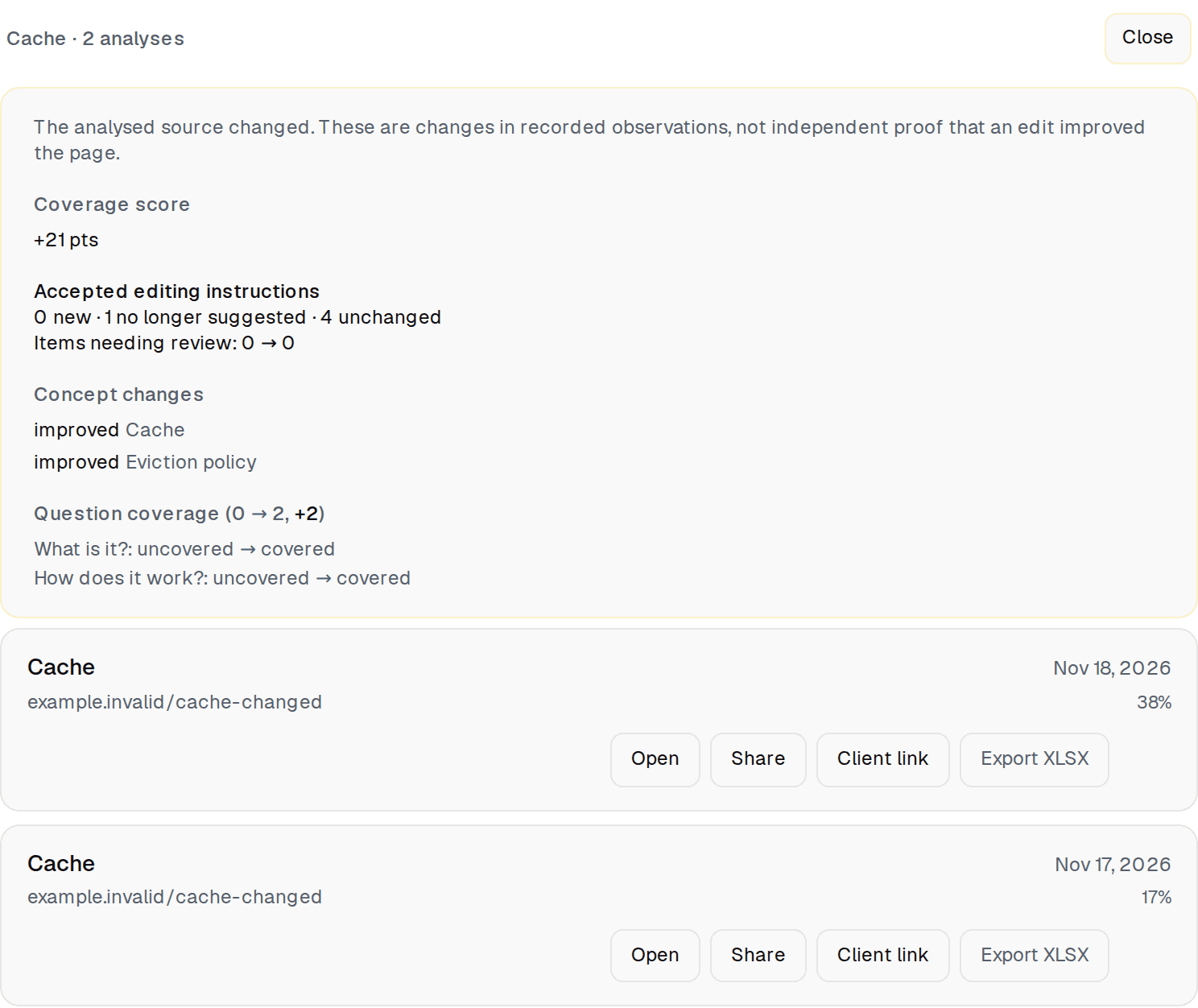
When your prose changes, History compares both snapshots against the same baseline and notes plainly that recorded observations are not independent proof of writing quality.
Try the two-pass check on a live draft
Map your page, tighten one section, and open Compare in History to see every change measured against the same baseline.
Four guardrails that keep determinism flexible
A steady baseline only helps if it steps aside the moment your page genuinely changes direction. Four rules keep the pipeline predictable without turning it rigid:
Topic pivots reset cleanly
If you genuinely repurpose a URL around a different subject, click Edit topic in the report header (or send redetectConcepts: true via API v1). Both clear the prior baseline immediately and run fresh discovery for the new topic.
Baselines stay private to your account or browser
Every baseline resolves strictly to your signed-in account (or anonymous browser session) and never writes to the shared global cache. Another person analyzing the same URL can never inherit or alter your concept map, and deleting your runs in History clears the baseline immediately.
Passing mentions cannot game a new concept onto the map
A suggested addition from Next steps only joins your map (up to 25 concepts total) after clearing two deterministic checks: text presence (calibrated across 232 pages in our Presence Premium study, requiring at least two mentions for single-word terms or a phrase/same-sentence match for multi-word terms) and verbatim quote verification. Unverified items are pruned automatically.
Older 15-concept URLs upgrade cleanly once
Clicking Re-analyze after editing on an older 15-concept report preserves that exact predecessor so an active editing loop never shifts midstream. Submitting the URL fresh upgrades it once to the 20-concept map and holds those 20 concepts steady from there.
What changes for the people using the reports
Writers & editors
Close gaps without chasing ghosts
Fix three thin sections, re-run in ~20 seconds, and see those exact three concepts respond without surprise additions muddying the read.
Content leads & agencies
Before-and-after deltas you can share
Send a Client link or export XLSX knowing Draft 1 and Draft 2 line up concept-for-concept and History distinguishes prose edits from setting changes.
DevRel & docs teams
Repeatable checks in API v1
Repeat URL runs via POST /api/v1/analyses keep a steady baseline per API account automatically, with redetectConcepts: true ready for deliberate doc refactors.
What this proves, and what it does not
Holding your baseline steady and verifying quotes against the page proves that coverage changes on Run 2+ measure your revised text rather than repeat-run noise. It does not guarantee Google rankings or promise AI citations. Search indexes and external models sit outside our control; giving you an honest, repeatable reading of your own prose does not.
Common questions
How does ContentGrapher apply determinism without freezing my report?
We put determinism in the structure and evidence while keeping prose judgment live. Application code holds your Run 1 concept list steady on repeat runs, counts mentions and verifies verbatim quotes directly against your text, keeps boundary roles steady while your page keeps its reader purpose, and reuses prior results in milliseconds when nothing changed. Explanation depth, concept links, diagnostic question coverage, and editing guidance all re-evaluate fresh whenever you revise the page.
Why did repeat analyses previously shift concepts on identical text?
Before we separated discovery from measurement, every uncached re-analysis asked the model to rediscover concepts from scratch. Even on identical prose, a language model makes slightly different choices about which 20 concepts to name. Across 232 untouched pages in our benchmark, that rotated 4 to 6 of every 20 concepts without a single word changing.
What happens if I cut a section or write a new topic ContentGrapher suggested?
If you cut a section covering a baseline concept, that concept stays visible on your map at 0 mentions and drops to underexplained so you can see the gap you opened. If you write a real section covering a recommended addition from Next steps, deterministic text checks and verbatim quote grounding promote it cleanly onto your map (up to 25 concepts) and carry it forward into future runs.
How do I start fresh if I rewrite a page around a different subject?
Click Edit topic in the report header to enter the new subject, or pass redetectConcepts: true through POST /api/analyze or POST /api/v1/analyses. Both clear the prior baseline and run fresh discovery for the new topic.
Steady baselines. Live feedback on every edit.
Good measurement has to hold still while your draft changes. By putting determinism in the structure and evidence while keeping reading live on every edit, ContentGrapher turns a concept map from a one-off snapshot into an editing instrument you can check twice and trust.
Your Run 1 concept map becomes your steady baseline on Run 2+; dashed nodes are suggested additions waiting for verified prose.