Why does my analysis show the same core concepts as last time?
The concept set reflects your page content, not your session history. A stable concept list across runs is a quality signal, not a cache artifact.
The gap diagnosis is driven by your page, not your session
The concepts appearing in your analysis are there because Phase 1 found them on the page, or found them structurally absent. This is not a cached result from a prior run. Phase 1 re-runs fresh on each analysis: it reads the current content of the page, builds a new concept map, and produces updated boundary classifications.
If you see the same concepts across sessions, it is because the same concepts are present, or absent, on the same page.
Stability is the expected result
In a 30-run controlled study, the same 12 concepts appeared in every single run across every audience condition tested, without exception. The pipeline found the same things because the same things are present on the page. A stable concept list across sessions is evidence that the analysis is working correctly, not evidence that something is stuck. These figures are from a controlled study on a single URL; counts on your page will vary with your content.
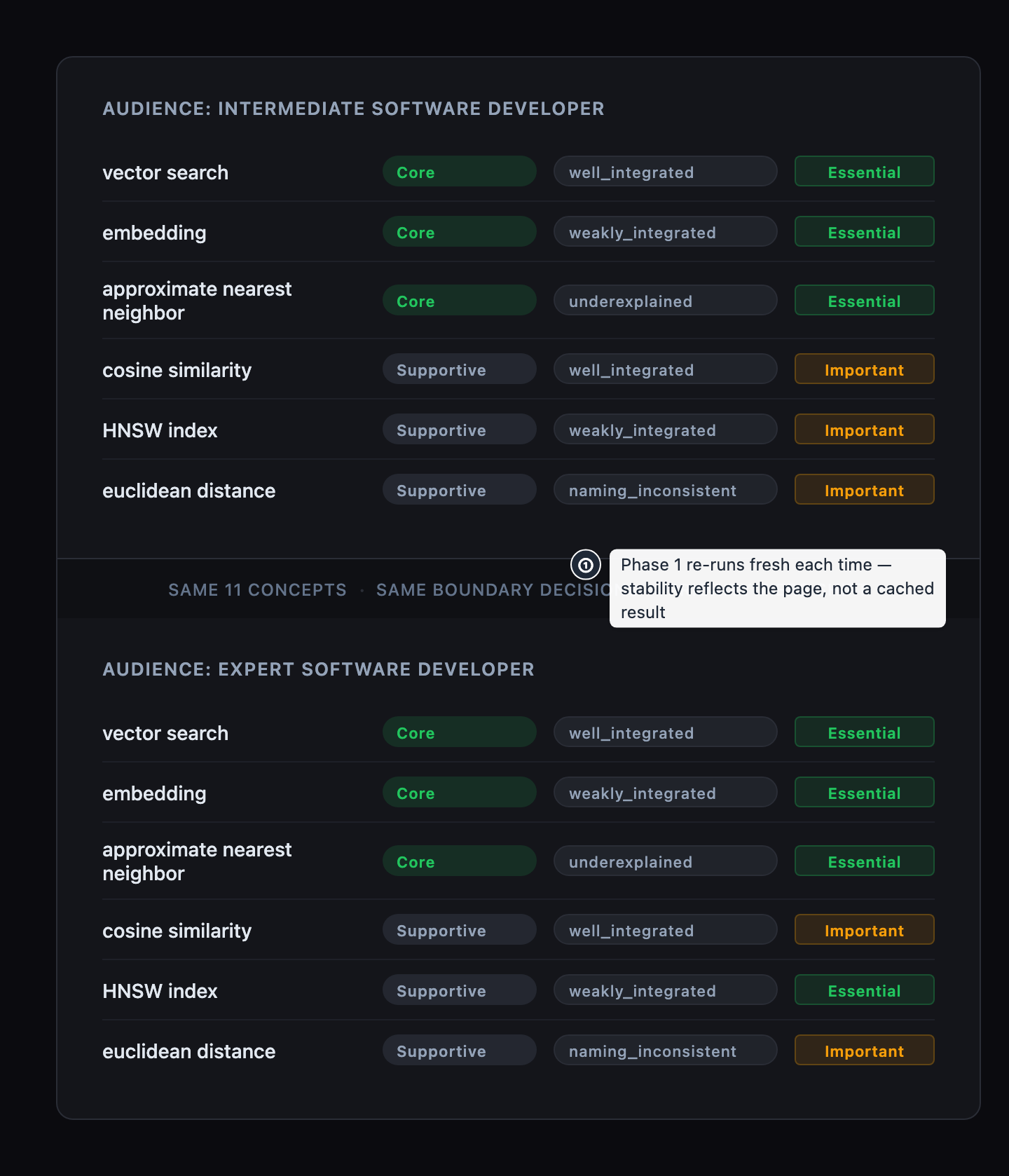
What the level does and does not change
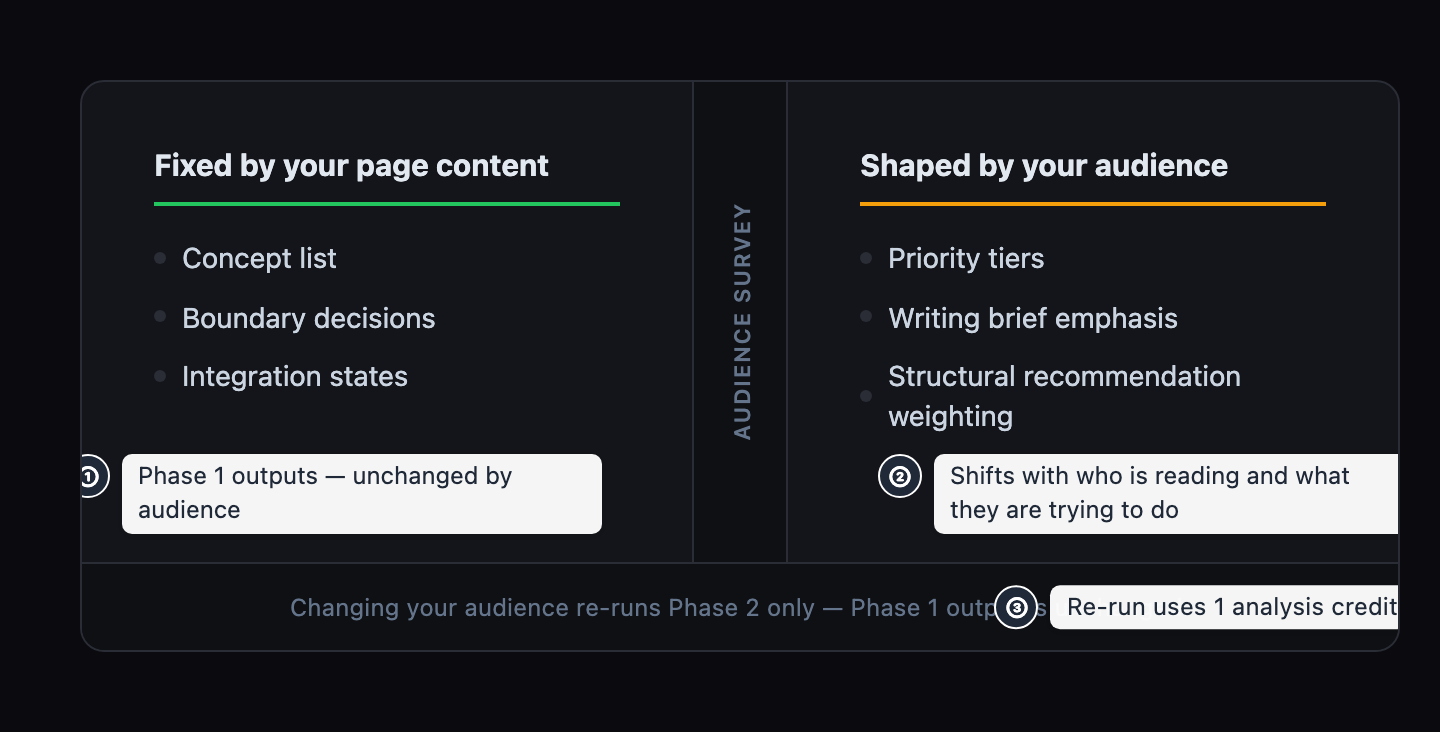
The knowledge level does not change which concepts appear. The level changes two things: how those concepts are prioritized (which are classified as essential, important, or useful) and how the writing guidance prescribes fixes for each gap. Changing the level between sessions will not produce a different concept list, but it will produce different priority tiers and different writing guidance.
Phase 2, which produces the priority assignments and writing brief, requires an analysis credit. Phase 1, which produces the concept list and boundary classifications, is free.
If you want the gap list to change
The only way to get a different concept list is to change the content on the page and re-analyze. Phase 1 will detect the change and produce an updated concept map. If you added or removed a major concept from the page, the next Phase 1 result will reflect it.
Related topics