What are the three guidance types?
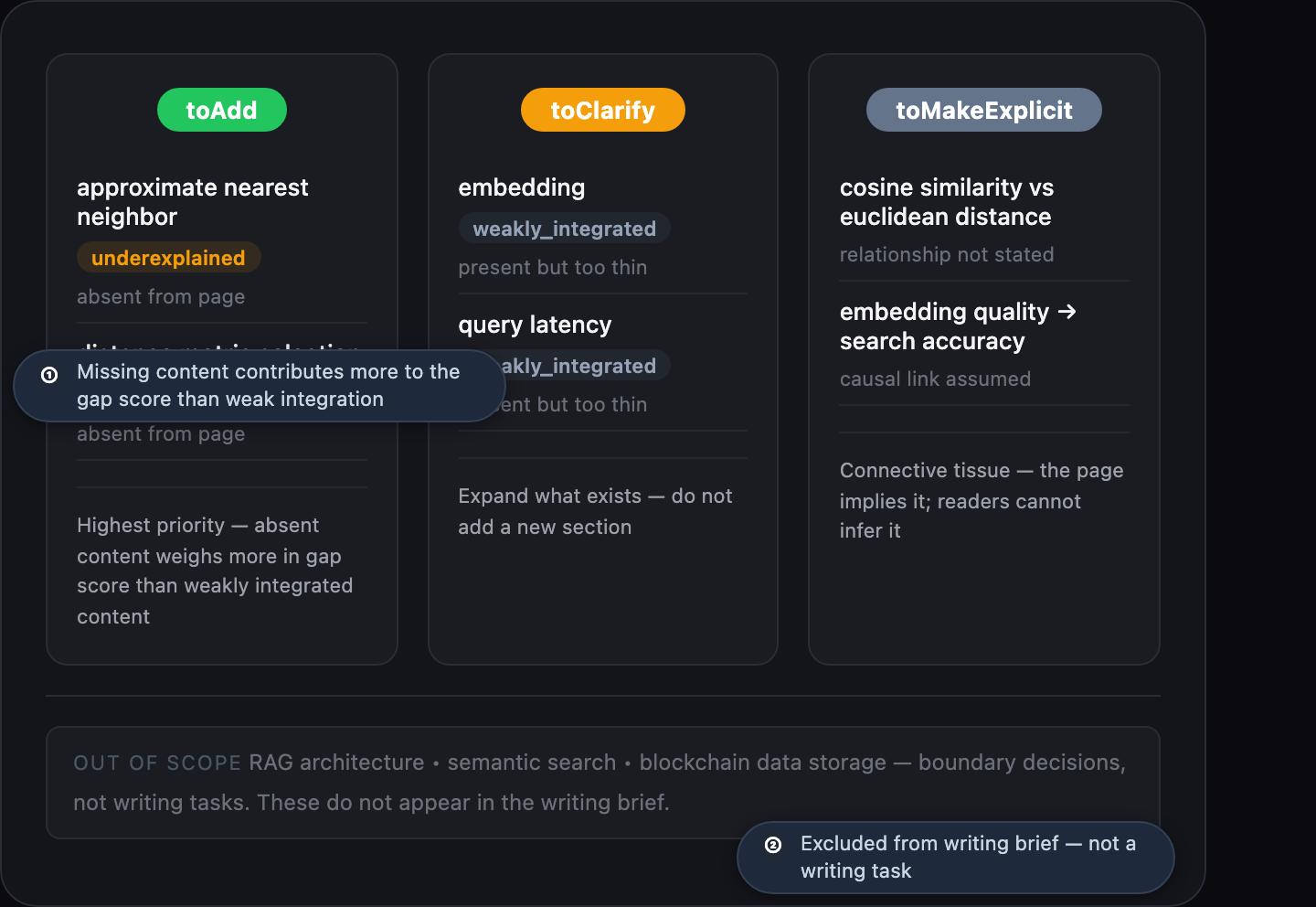
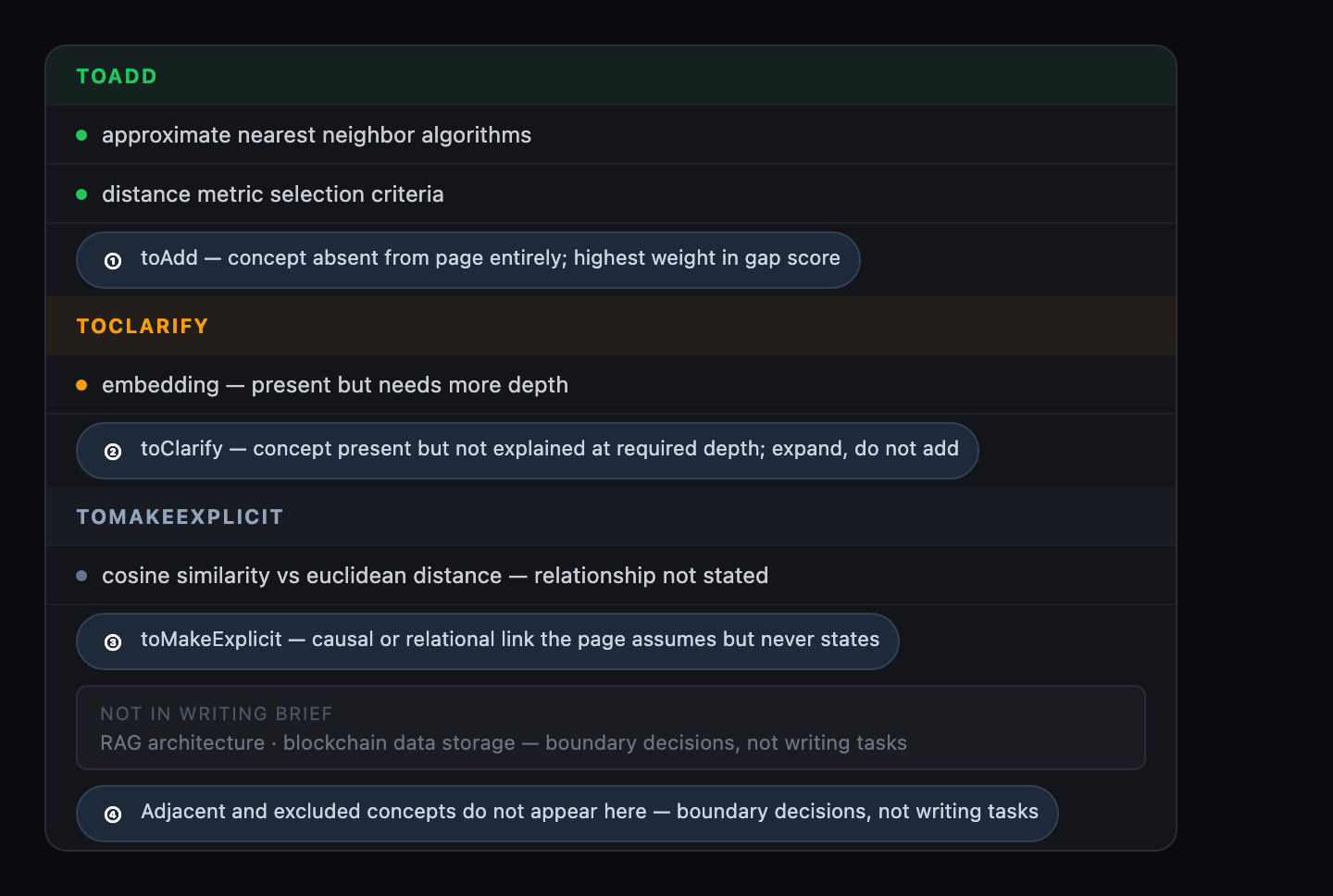
The writing brief has three sections: "What to add", "What to clarify", and "Relationships to make explicit". Each addresses a different type of structural gap in the same concept set.
Three types of gap, three types of fix
All three sections of the writing brief address the same gaps the analysis identified. The difference is the type of fix required. "What to add" covers content that is entirely absent from the page. "What to clarify" covers content that is present but too vague or implicit to serve the reader. "Relationships to make explicit" covers relationships between concepts that the page implies but does not state directly. A concept may drive items across sections: a concept in "What to add" can also appear in "Relationships to make explicit" if a key relationship involving it is also absent. But "What to add" and "What to clarify" are mutually exclusive for the same concept — a concept is either absent from the page or present; it cannot be both.
The writing brief and all Phase 2 outputs require an analysis credit. Phase 1, which produces the concept graph and boundary classifications, is free.
What to add
These items are concepts that do not exist on the page at all. The explanation framework for your topic and audience requires them, but Phase 1 found no evidence of them in the content. These represent the highest-priority gaps: a concept that is absent entirely is a more significant structural gap than one that is present but underdeveloped.
Example: "Add a dedicated explanation of the Boundary Layer feature, naming it explicitly and describing what it does: it enforces concept scope at the page level to prevent dilution. Right now it is mentioned but not explained as a mechanism. Expert strategists need to understand it as the enforcement layer that makes primary retrieval role actionable, not just a label."
What to clarify
These items are concepts that are present in the content but not explained at the depth required for the stated reader. They are named or mentioned, but the explanation is too thin, too vague, or too implicit to serve the reader's task.
Example: "Structural completeness is the central diagnostic criterion but the current content treats it as self-evident. Add a sentence that defines it operationally, what makes a piece of content structurally complete versus incomplete, so readers have a working definition they can apply to their own content." Items in this section typically require expanding an existing section, not adding new content.
Relationships to make explicit
These items are the connective tissue: causal, relational, or logical links between concepts that the page assumes rather than states. When a reader, or an AI retrieval system, cannot find the connection stated directly, that link is invisible.
Example: "State the causal relationship directly: RAG-based retrieval requires structural completeness because retrieval systems evaluate concept coverage, not just topical relevance. This is the foundational 'why' that makes everything else on the page make sense."
Adjacent and excluded concepts do not appear here
Concepts the pipeline classified as adjacent or excluded in Phase 1 do not appear in any of the three sections. This is intentional. Writing more about an out-of-scope concept does not improve the page's structural completeness. The response to an adjacent or excluded concept is a scope decision, not a writing task.
If a concept appears in your concept graph but not in the writing brief, check its boundary classification. That is the most direct explanation for its absence.
Related topics