You may now analyze Japanese, Korean, Chinese, Arabic, and other non-Latin-script pages
You can now analyze Japanese, Korean, Chinese, Arabic, and other non-Latin-script pages and get a full coverage score and concept map. Writing guidance is held back for now rather than shown at a quality level we cannot stand behind.
Problem
A decorrelated adversarial panel rated the writing guidance for natively-authored Japanese pages at 17% fully actionable and Korean at 0%. The guidance was never wrong — it was specific, in-language, and technically accurate. The panel's objection was different: the guidance assumed an English rhetorical frame. Thesis-first ordering. Explicit causal chains. "Pick one canonical term and stick to it." Those are English expository conventions. On a Japanese or Korean page written for readers accustomed to a different reading contract, that guidance tells authors to rewrite in ways that may not serve their audience.
Shipping guidance we know is 0–17% actionable is not a viable path. The question was what to replace it with.
Context
Before building a fix, we ran a research study to understand whether the fix was actually what the panel's diagnosis suggested: adapt the guidance to native rhetorical conventions, specifically the delayed-thesis / inductive-ordering / reader-responsible framing that the academic literature associates with Japanese and Korean writing.
The research found the premise was more contested than the panel's verdict implied. 99 agents, 5 search angles, 17 sources fetched, 25 claims verified, 7 killed.
The core finding: the classical picture of JA/KO writing as inductive, thesis-delayed, and reader-responsible has been repeatedly criticized by the field's own scholars as an essentializing stereotype that frames these writers' choices as deficient rather than different (Kubota & Lehner, 2004). The recent corpus work cuts against the stereotype too. Korean students front-loaded the thesis in 70% of essays; only 15% used the four-part ki-swung-cen-kyel structure typically associated with Korean rhetoric. Japanese research-article introductions showed no evidence of thesis delay. Prescriptive Korean writing norms at major universities now explicitly teach linear, writer-responsible structure. Hinds' original reader-responsibility framework grouped Japanese and Korean together, but the Korean classification was made by inference from shared syntax — not Korean discourse data — and is actively contested.
The panel's diagnosis ("you are imposing English conventions") was directionally right — the guidance needed work. But the fix was not to hardcode a different set of conventions that the academic literature says are themselves a dated, genre-bound stereotype. The LLM panel may have been reinforcing a shared bias, not identifying a ground truth about how Japanese or Korean explanatory web content should be structured.
Why now
We had two options. The first was to ship the partial-tier guidance as-is and let users deal with guidance we know is English-convention-biased. The second was to withhold the guidance while we build a validated set of per-language priors that the evidence can actually support.
The research settled it. There is a small set of evidenced Japanese-specific priors that are safe to test — question-raising openers rather than explicit thesis framing, less promotional centrality-claim language, not penalizing implicit connections or term variation as defects. But those need to be validated on ContentGrapher's own web panel before being encoded, not shipped as fixed rules. The structural rework the panel's diagnosis seemed to call for is not justified by the current evidence. Encoding "delay your thesis" as a JA/KO writing directive would mean teaching the stereotype, not solving the problem.
What changed
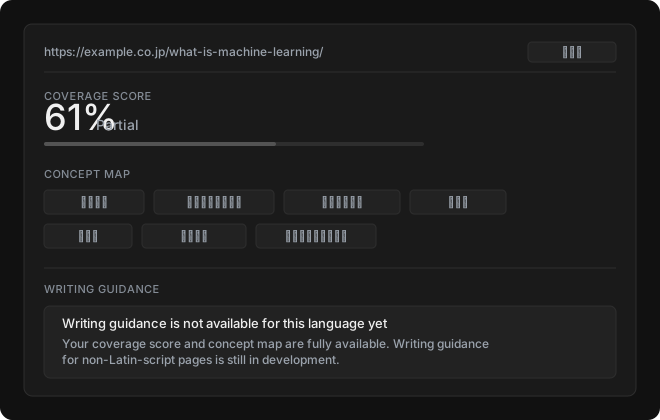
Coverage score and concept map are fully available for all non-Latin-script pages. Japanese, Korean, Chinese, Arabic, and other non-Latin analyses run the full Phase 1 pipeline and return a complete concept graph, coverage score, and depth assessment. Nothing changes there.
Writing guidance is withheld for non-Latin-script analyses. In place of the guidance panel, a hold notice appears: "Writing guidance is not available for this language yet." This is surface (b) in the rollout model — scored-only, with guidance withheld rather than shipped below a confidence floor we can stand behind.
The flag is off by default, system-wide. The NON_LATIN_GUIDANCE_BETA flag gates writing guidance exposure for all non-Latin scripts. With it off, no JA/KO/ZH/AR guidance reaches users. This is the code anchor for the eventual flag-gated opt-in beta, which ships when a language clears its actionability floor and survives the decorrelated panel with no active hold.
Latin non-English pages are unaffected. French, German, Spanish, Italian, Dutch, and other Latin-script non-English analyses continue to receive full writing guidance as before. The withholding applies only to non-Latin scripts where Phase 2b writing guidance has not yet cleared the actionability bar.
What comes next: a small set of evidenced Japanese-specific priors (question-raising openers, reduced centrality-claim framing, no penalty for implicit connections or term variation) is scoped for the next round of work. Each directive needs validation on ContentGrapher's own JA/KO web panel before it ships. The flag flips on per language, not as a block, so Japanese and Korean certify independently when the evidence supports it.